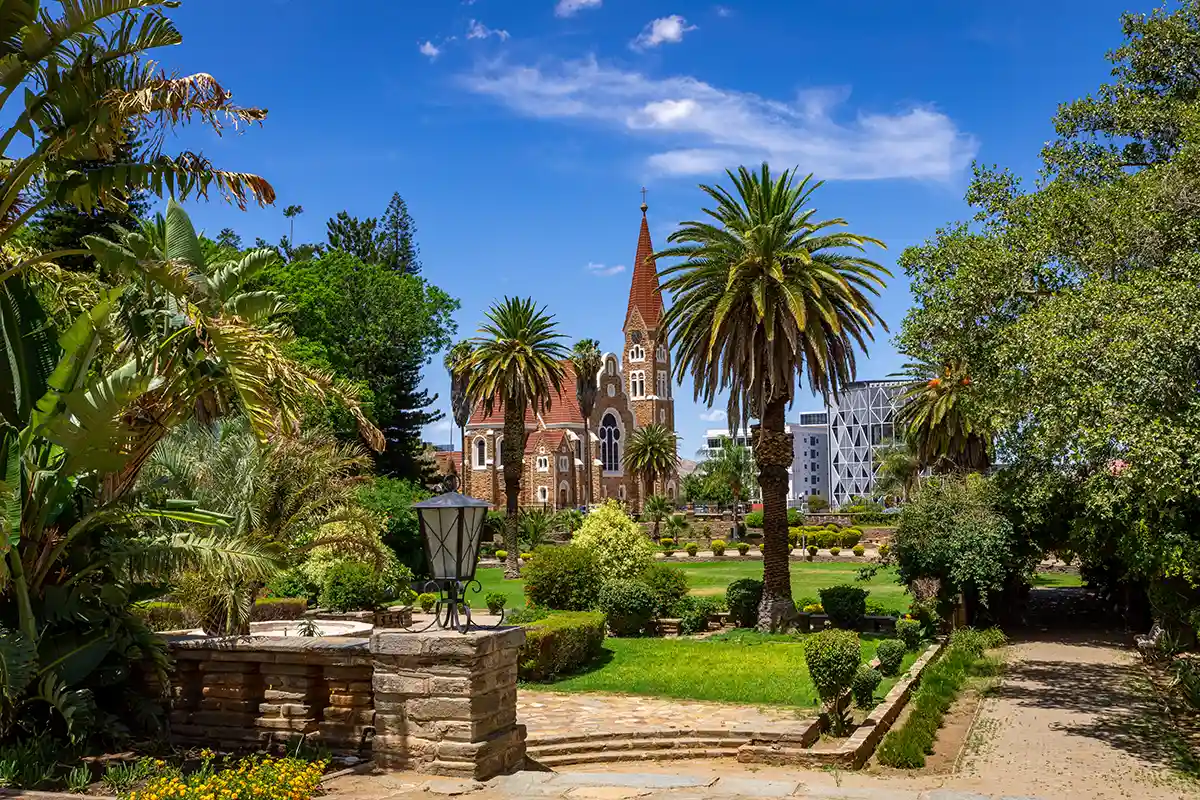
Swakopmund hero image to follow — placeholder using Windhoek's Wilhelmine architectural framing as a visual cousin.
© Curioso Photography / Adobe Stock
Översikt
Wilhelmine Coastal Town
Sandboarding & Dune Adventure
Walvis Bay Flamingos & Sea Kayaking
Cape Cross & Skeleton Coast
Brewery & Café Culture
Living-Desert & Welwitschia Drive
Historia
Kultur
Praktisk info
Swakopmund is the Atlantic coast's only proper town and one of the strangest small cities anywhere — a Wilhelmine-Lutheran spa town with Bavarian half-timbered hotels and a working German brewery, set on a thin strip of beach between the world's oldest desert and the cold Benguela Current. Founded in 1892 as the German South-West African port (the river-mouth on the Swakop, hence Swakopmund), the town now serves as the country's coastal-adventure capital and the natural counterpart to inland Windhoek. It is 365 kilometres west of Windhoek on the B2 (a four-hour drive through the Namib-Naukluft on tar all the way), 31 km north of Walvis Bay (Namibia's working deep-water port and the better wildlife-on-water base), and the southern gateway to the long Atlantic coast that runs north as the Skeleton Coast to the Angolan border. The town is cool and grey for most of the year — the Benguela Current keeps coastal temperatures between 15 and 22 °C even in summer, fog rolls in at night, and December–January is the only window of properly warm days. The architectural personality is concentrated on a few blocks around the Hohenzollernhaus, the Woermann House, the Old District Court, the Mole (the original stone breakwater) and the Jetty: half-timbered facades, ornate brick gables, a small Lutheran church and a sandstone lighthouse, all set against an immediate edge of dunes and wide Atlantic. The food and drink scene is famously deep for a town of 75 000 — the Swakopmund Brewery, Café Anton on Bismarck Strasse, Käpps & Konditorei (one of the country's better bakeries), the Tiger Reef beach bar, the Jetty 1905 fine-dining restaurant and the more recent specialty-coffee scene around Kramersdorf. Most Namibia itineraries spend two or three nights here — the natural pause-and-recovery point between the inland safari leg and the southern desert leg, with enough activities to fill those days.
Upptäck Swakopmund
Swakopmund's German-colonial centre is denser than Windhoek's: the Woermann House (1894, the regional administrative HQ, now a city museum and library), the Old District Court (Altes Amtsgericht, 1908, half-timbered with a copper-clad clock tower), the Hohenzollernhaus (1906, the original casino, now apartments), the Marine Memorial (Marine-Denkmal), a 1908 bronze statue from the German colonial period, and the small brick-and-thatch Lutheran church (1911) at the foot of Bismarck Strasse. The Mole — the original stone-walled harbour built in 1899 and silted closed within a decade — survives as the town's small lagoon, beach pool and the icon of Swakopmund postcards; the Strand Hotel and the Tiger Reef beach bar sit at its head. The Jetty (Landungsbrücke), the wooden pier extending into the Atlantic, was the original landing point before the Mole — its current 262-metre length is a 2006 rebuild, and the Jetty 1905 restaurant at its end is the town's signature fine-dining destination. The Swakopmund Lighthouse (1903) standing 28 metres tall in red and white still operates and is the town's universally photographed icon.
Transport och flygplatser
Turism och resmålsguider
Official town tourism portal. Activity directories, event calendar, accommodation listings and the practical visitor information.
National destination marketing organisation — trip-planning resources, registered-operator directories, festival calendar, and the e-Travel permit portal.
State-run rest-camp bookings — Terrace Bay in the Skeleton Coast Park, Sesriem (Sossusvlei), the Etosha camps and the other state parks. Books up to 11 months ahead.